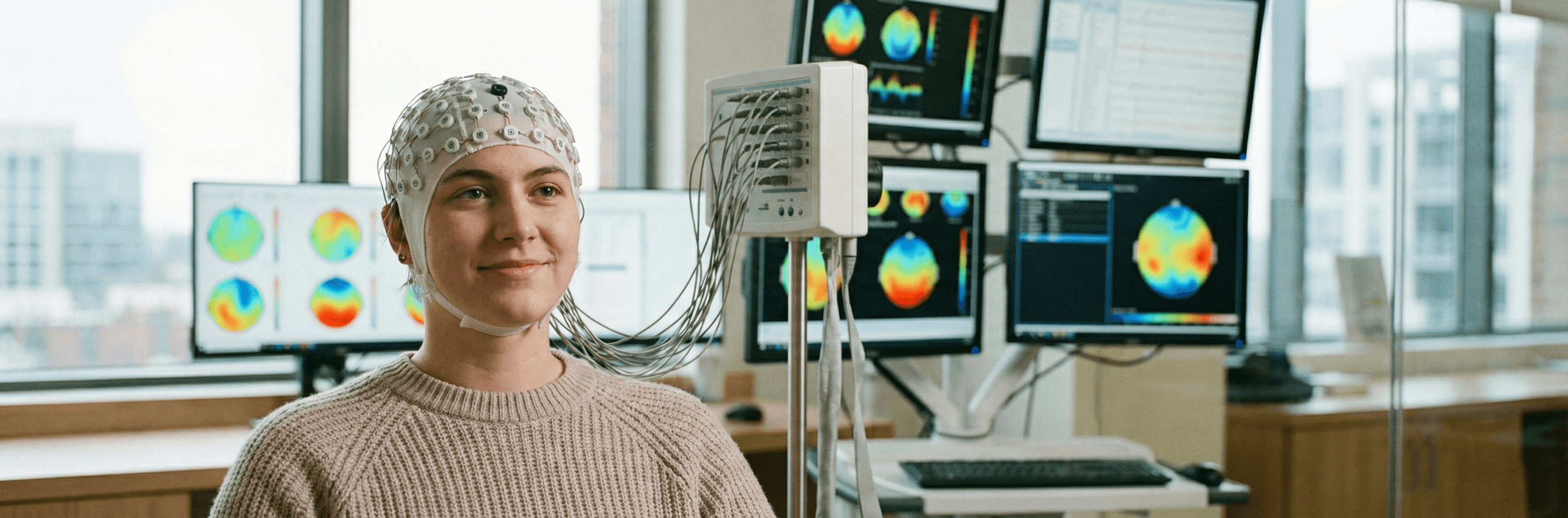
Neurofeedback for ADHD has an appealing rationale: give a person feedback about brain activity and train a pattern associated with attention. The central clinical question is whether that feedback produces a meaningful improvement in ADHD beyond the other parts of the training experience.
The distinction matters for families weighing a substantial commitment of time and money. A child can improve during a program while the study remains unable to identify a specific effect of the EEG feedback. Good research is designed to separate those possibilities.
The large sham-controlled trial
The Neurofeedback Collaborative Group's randomized trial enrolled 144 children aged seven to ten with ADHD and elevated theta/beta ratios. It compared deliberate theta/beta training with a carefully matched control using recorded EEG feedback. Participants could receive up to 38 sessions.
The ratio compares power in two frequency bands. In this trial, rewards depended on reducing theta activity at 4 to 8 cycles per second while increasing beta activity at 13 to 21 cycles per second. Children saw game points linked to that target. In the control, recorded EEG supplied the feedback instead, while the child's own movement and muscle artifacts could still affect it to help preserve blinding. Both groups received similar sessions and sleep and nutrition counseling.
Both groups improved. The primary inattention outcome showed no significant advantage for genuine feedback at treatment end or the 13-month assessment. A secondary medication-use finding favored neurofeedback at follow-up, but it should be interpreted alongside the primary result and its exploratory status.
The elevated ratio was part of the entry criteria. That makes this a test of a particular training target in children selected for that feature. It leaves a different question open: whether choosing among several protocols with a broader QEEG assessment improves outcomes.
Where individualized protocols fit
Individualized training is a separate hypothesis worth testing. In an open-label pilot by Arns and colleagues, participants receiving QEEG-informed neurofeedback improved over time. The absence of a blinded control leaves nonspecific effects and other explanations unresolved.
To demonstrate that QEEG matching improves treatment selection, a study would need a suitable comparison of selection approaches and meaningful clinical outcomes. A favorable before-and-after result in a matched program cannot, by itself, show that matching caused the advantage.
That leaves room for research without making the finding carry more weight than its design allows. It also gives you a precise question to ask when a program claims to have solved the limitations of earlier trials.
Read the broader evidence with the same standard
A 2025 review of randomized trials found an overall null result on probably blinded total ADHD symptoms, with a small effect in a standard-protocol subgroup. It did not support neurofeedback as a stand-alone treatment. Rater knowledge, protocol differences and follow-up limitations all matter to interpretation.
For children, established care includes clinical assessment and age-appropriate behavioral, educational and medication options. The American Academy of Pediatrics guideline gives those recommendations in context. An elective training program should be considered alongside that care, with changes in medication handled by the prescribing professional.
Make the decision concrete
Ask what your child would be expected to do differently in ordinary life. Fewer lost instructions, easier homework starts or improved classroom functioning are clearer goals than achieving a preferred color on a map. Agree on measures that are appropriate to those goals and, where possible, include observations from more than one setting.
Ask when progress will be reviewed and what happens if it remains limited. Include the time spent setting up and attending sessions in your cost calculation. A program's advertised number of sessions describes its provision, rather than a proven requirement for every child.
The cost guide can help you compare a complete quote. The QEEG article explains what an assessment can and cannot establish.
You can be interested in neurofeedback and still require a careful account of its evidence. A useful plan makes the uncertainty visible, protects access to established care and judges success by changes that matter to the child.
References
- The Neurofeedback Collaborative Group (2021). Double-Blind Placebo-Controlled Randomized Clinical Trial of Neurofeedback for Attention-Deficit/Hyperactivity Disorder With 13 Month Follow-up. doi:10.1016/j.jaac.2020.07.906
- Arns M; Drinkenburg W; Kenemans JL (2012). The Effects of QEEG-Informed Neurofeedback in ADHD: An Open-Label Pilot Study. doi:10.1007/s10484-012-9191-4
- Westwood SJ; Aggensteiner P-M; Kaiser A; et al.; for the European ADHD Guidelines Group (2025). Neurofeedback for Attention-Deficit/Hyperactivity Disorder: A Systematic Review and Meta-Analysis. doi:10.1001/jamapsychiatry.2024.3702
- Wolraich ML; Hagan JF Jr; Allan C; et al. (2019). Clinical Practice Guideline for the Diagnosis, Evaluation, and Treatment of Attention-Deficit/Hyperactivity Disorder in Children and Adolescents. doi:10.1542/peds.2019-2528
Get new articles and brain training insights by email.
No spam, unsubscribe anytime.
Related Articles
EEG Phenotypes: Patterns, Uses and Limits
What recurring EEG patterns describe, how recording conditions affect them, and why a brain map needs context before it guides training.
Is Neurofeedback Legitimate? Evidence and Limitations
Examine how neurofeedback works, what controlled studies show, and the questions that help distinguish responsible practice from unsupported promises.
Neurofeedback Cost: Prices, Packages and Questions
Compare neurofeedback program costs, understand what a package includes, and ask useful questions about reassessment, refunds and possible non-response.
About Dr. Andrew Hill
Dr. Andrew Hill is a neuroscientist, founder of Peak Brain Institute and host of the Head First podcast. He writes about neurofeedback, attention, learning and brain health.
Get Brain Coaching from Dr. Hill →